Guide
Thermador vs Wolf Ranges: A Repair Technician's Comparison
Reviews compare these ranges on cooking. This compares them on what breaks, what it costs to put right, and which design decisions matter ten years in.
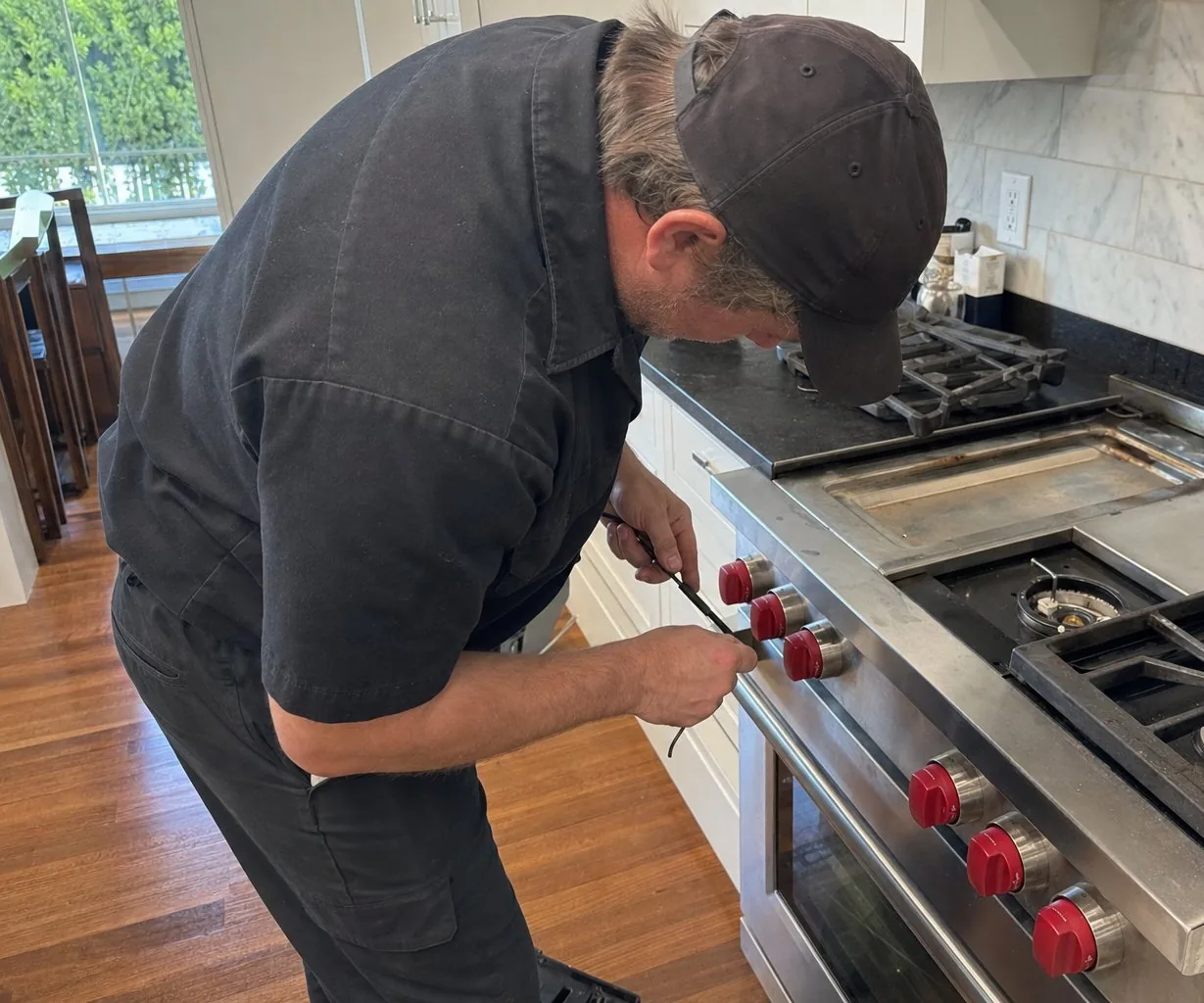
Almost every comparison of these two ranges is written by someone who cooked on them for a week. This one is written from the other end of the appliance’s life: what we find when we open them, what fails, and what the repair costs. It is a narrower question than “which is better”, and for anyone who already owns one it is a more useful one.
Both are genuinely good equipment. Neither has a systemic flaw. What they have is different design philosophies, and those show up in the repair bill.
The burner argument, seen from underneath
Wolf uses dual-stacked sealed burners: two rings of ports at different heights, so high output and a genuine low simmer come from the same burner without a separate simmer plate.
Thermador uses the Star burner, a star-shaped port geometry that spreads flame over more of the pan base, paired with ExtraLow — a mode that holds very low heat by pulsing the flame rather than burning continuously at a minimum.
In service terms: the Wolf arrangement has more ports in a smaller area, so it is more sensitive to boil-overs and to the burner cap being seated squarely. Most Wolf surface complaints we attend are port blockage or a cap sitting proud, both of which are cheap. Thermador’s star geometry blocks less readily, but ExtraLow generates a support call of its own — owners report the burner “going out and relighting” when what they are seeing is the feature working as designed. We have closed more than a few Thermador calls with an explanation rather than a part.
Ignition and the shared-module problem
Both brands run a shared spark module across the cooktop, so on both, a single fouled or cracked electrode makes every burner click. That symptom is not diagnostic of the brand, and on either range the cheap causes come first: cap seating, port blockage, cracked electrode ceramic, moisture.
The practical difference is access. Getting at Wolf ignition components generally means working from the top down; several Thermador configurations want more of the control panel off. That is labour time rather than parts cost, but over a couple of hours it is real.
Ovens: where the two diverge most
Wolf’s dual-fuel design pairs gas surface burners with an electric oven, and the electric oven is the reason a lot of people buy the range — it holds calibration well and the convection is even. When a Wolf oven goes wrong, it is usually electronic: a control board, a relay, a sensor, or on older units, a display.
Thermador wall ovens and range ovens are also electronically controlled, and Thermador’s calibration offset is more generous and easier to use. A Thermador oven that is consistently 20–25 degrees out is frequently a calibration job rather than a parts job — which is the cheapest repair there is.
The honest pattern we see: Thermador ovens more often come in with a drift you can calibrate out; Wolf ovens more often come in with a discrete component that has failed and needs replacing. Neither is worse. One tends to produce a short calibration visit, the other a $400–$850 control repair — but the Wolf will then be exactly right again, where a calibration masks a sensor that is slowly going.
Build, and what that means in year twelve
Both are heavy, serviceable machines with parts availability that is genuinely good a decade out — which is not true of everything in this price class. Neither brand strands owners.
Where they differ is in how much of the appliance is electronic. Wolf’s dual-fuel design necessarily puts more electronics in the range. Thermador’s professional gas ranges keep more of the cooking function mechanical. On the North Shore, where storm outages and surges are a routine fact of life, that matters: surge damage to a control board is one of the failure modes we see most after a nor’easter, and the more boards an appliance has, the more exposure it has.
The mitigation is the same for both and costs very little: put surge protection ahead of the range.
What each actually costs to keep running
These are the same all-in ranges we publish on our pricing page — parts and labour, for premium built-in cooking equipment on the North Shore:
| Repair | Typical range |
|---|---|
| Range / oven repair | $250–$900 |
| Cooktop repair | $200–$750 |
| Control board / electronics | $400–$850 |
| Door gasket / seal replacement | $150–$450 |
| Diagnostic / service call | $95–$149 |
The diagnostic is $95, credited toward the repair. Across a ten-year ownership the two brands land in much the same place. What differs is the shape: Thermador skews toward more frequent, cheaper visits; Wolf toward fewer, larger ones.
If you are choosing rather than repairing
Two things are worth knowing before the kitchen is built, because they are expensive to change afterwards:
Ventilation. Both brands are specified against real extraction rates. A hood that is undersized for the range will not stop it cooking, but it will put more heat and grease into the control area, and control-area heat is what ages electronics.
Clearance and service access. A range built into joinery with no way to pull it forward turns a two-hour repair into a four-hour one, every time. This is the single most common avoidable cost we see in newly renovated kitchens on the peninsula.
The short version
If you already own one: neither brand is a mistake, and both are worth repairing rather than replacing. Learn your own range’s normal behaviour — particularly ExtraLow on a Thermador, which is the most common non-fault in this comparison.
If you are choosing: pick on how you cook. From a service standpoint there is no clear winner, only a different distribution of cost over time.
Gold Coast Appliance Repair is an independent specialist covering Sands Point and Nassau County. We are not affiliated with Wolf, Thermador or any manufacturer, we install genuine OEM parts, and every repair carries a 1-Year Parts & Labor Warranty. Call (914) 483-3420.