Guide
Sub-Zero Compressor Replacement: What It Involves and When It Is Worth It
Most Sub-Zero units sent for compressor replacement do not need one. How to tell a genuine compressor failure from the faults that imitate it, and what the real job involves.
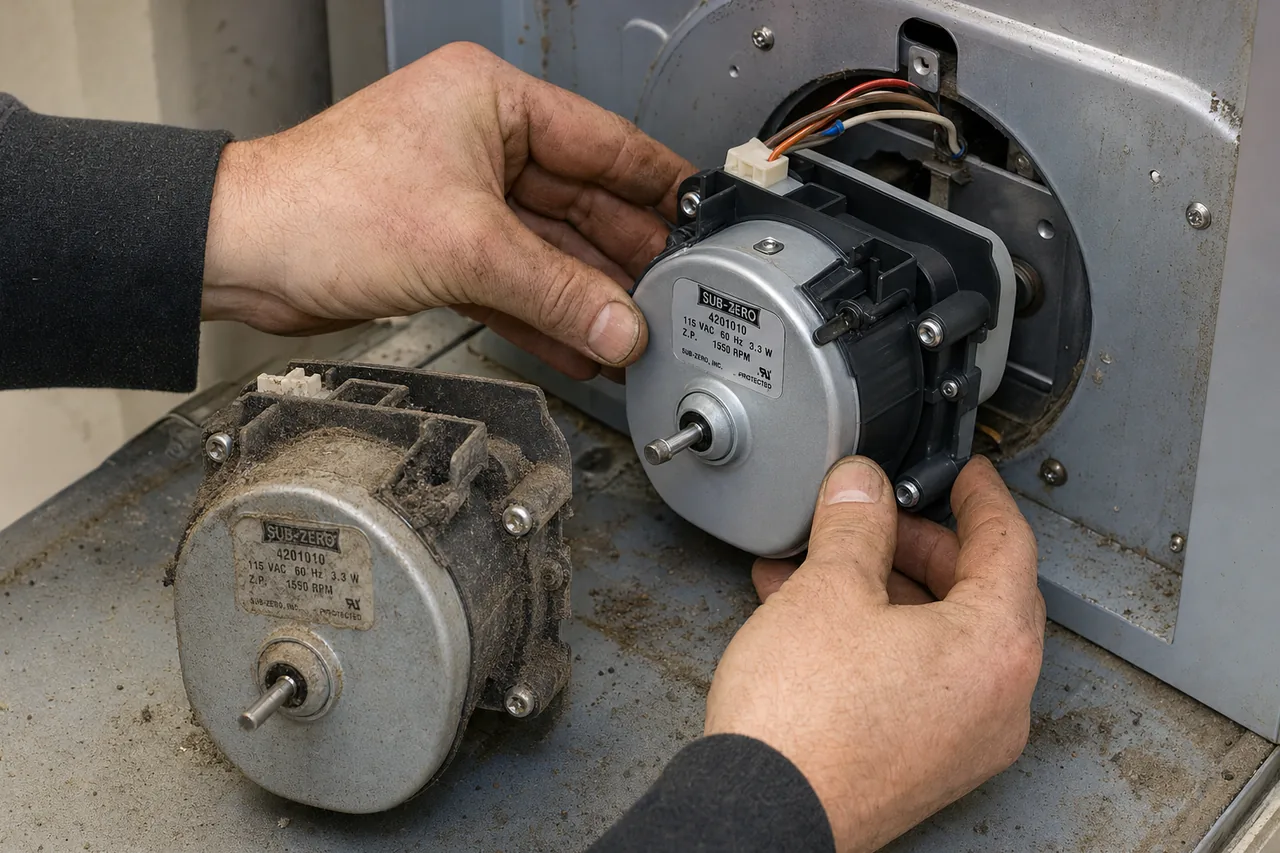
“It needs a new compressor” is the most expensive sentence in refrigeration, and on a Sub-Zero built-in it is wrong more often than it is right. Before anything else, it is worth knowing what actually has to be true for a compressor to be the answer — because four cheaper faults produce almost exactly the same symptoms.
First: this cabinet has two of everything
A Sub-Zero built-in runs two independent sealed refrigeration systems, one for the fresh-food compartment and one for the freezer. Each has its own compressor, its own evaporator and its own defrost cycle.
That single fact settles a lot of arguments. If your freezer is rock solid and the refrigerator side is at 50°F, you do not have a failing appliance — you have one failing circuit, and the other one is proving that the electrical supply, the controls and the cabinet are all fine. It also means a compressor replacement on one side does not touch the other.
The four things that imitate a dead compressor
A seized or failing condenser fan. The compressor runs, the refrigerant circulates, but the heat has nowhere to go. Compartment temperature climbs, the compressor runs constantly, and the unit feels hot at the grille. Identical symptoms, a fraction of the cost.
A loaded condenser coil. Same outcome, no failed part at all. This is the single most common cause of “my Sub-Zero is dying” on the waterfront, because damp salt air makes dust stick to the coil instead of passing through it. A coil that is genuinely packed will push head pressure up far enough to mimic a struggling compressor — and if it is left long enough, it will eventually cause one.
A defrost failure. The defrost heater or its termination thermostat stops working, frost builds on the evaporator until it becomes a block of ice, and airflow across the coil stops. The compartment warms while the compressor runs perfectly. You can often confirm this one by eye: ice sheeting behind the rear freezer panel.
A start relay or overload. The compressor itself is healthy but the device that starts it has failed. You get a click, a hum, a few seconds of effort and then silence, repeating every several minutes. This is a cheap part that fails far more often than the compressor it protects.
A competent diagnosis rules all four out before anyone talks about the sealed system.
What a genuine compressor failure looks like
There are a few signatures that do point at the compressor:
- It draws locked-rotor current and never starts, with a known-good start relay and overload fitted.
- It runs, but the system develops no meaningful pressure differential between the low and high sides.
- It has an internal electrical fault — a winding open, or a winding shorted to the shell.
- It is mechanically noisy in a way that changes with load, having previously been quiet.
Those are measurements, not impressions. Every one of them requires gauges or a meter on the unit.
What the job actually involves
Compressor replacement on a built-in is a sealed-system repair, and it is the most technical work done on domestic refrigeration. In order:
- Recover the refrigerant. It is illegal and environmentally indefensible to vent it. Recovery is done into a certified recovery machine and cylinder by an EPA Section 608 certified technician.
- Cut the compressor out and fit the replacement, brazed in rather than clamped.
- Replace the filter-drier. This is not optional and it is where shortcuts show up months later. A system that has been opened has taken on moisture, and the old drier is already saturated.
- Pressure-test and then evacuate deeply. Pulling the system down to a deep vacuum and holding it is what removes moisture and non-condensables. A system that is charged without a proper evacuation will run — for a while — and then acid-etch itself from the inside.
- Charge by weight, not by feel. These systems use a critical charge. A few grams out in either direction changes the performance envelope.
- Run it and verify. Temperature pull-down across both compartments, current draw, and cycling behaviour over a period, not a spot reading.
That sequence is why sealed-system work is priced where it is: in our area, typically $800–$2,200 depending on the circuit and the model, against $300–$750 for the common non-sealed faults.
When it is worth doing — and when it is not
The case for repair is usually strong on this equipment, and it comes down to what a Sub-Zero built-in actually is. The cabinet is vacuum-insulated, the joinery is built around it, and the unit was engineered for a twenty-year-plus service life. Replacing it is rarely a matter of buying an appliance; it is a kitchen job, because the new unit has to fit an opening and carry panels that were made for the old one.
Against that, an $800–$2,200 sealed-system repair on a fifteen-year-old unit whose other circuit is healthy and whose cabinet is sound is usually good value.
The case weakens when: the second sealed system is also showing symptoms; the cabinet has been damaged — a punctured vacuum panel cannot be repaired and the insulation value does not come back; there is visible corrosion through the liner; or the unit has already had a sealed-system repair that did not hold, which often means contamination that a second attempt will not clear.
We will say which of those applies. On this equipment the honest answer is usually “repair it”, and when it is not, saying so is worth more than the job.
Two things that prevent the whole conversation
Clean the condenser. Every three months on a waterfront Sands Point property, every six inland. It is the highest-value maintenance action available to a built-in refrigeration owner and it is the one that most directly protects the compressor.
Fit surge protection. Storm outages on the peninsula take out control boards, and a control fault that leaves a compressor short-cycling will do real damage before anyone notices the temperature.
If your Sub-Zero is running constantly, warm on one side, or icing up behind the freezer panel, get it measured before anyone quotes a compressor. The $95 diagnostic is credited toward the repair. Gold Coast Appliance Repair is an independent specialist, not affiliated with Sub-Zero, and every repair carries a 1-Year Parts & Labor Warranty. Call (914) 483-3420.